The Doctor Who Was Right and Lost Everything
In the middle of the 19th century, a Hungarian physician named Ignaz Semmelweis made a discovery that should have saved thousands of lives. Instead, it cost him his career, his reputation, and ultimately his life. His story is one of the most important cautionary tales in the history of science — and one of the most relevant to anyone who has ever tried to challenge the status quo inside a large organization.

The Discovery
Semmelweis was working in a Vienna maternity ward in the 1840s when he noticed something deeply troubling. Women giving birth in the ward staffed by doctors and medical students were dying at a dramatically higher rate than women in the ward staffed by midwives. The difference was stark. The data was undeniable. He set out to understand why.
What he found was that the doctors were moving directly from performing autopsies to delivering babies — without washing their hands. He hypothesized that something was being transferred from the cadavers to the patients. He did not have the language for it yet — germ theory would not come for another two decades — but he had the data. He introduced mandatory handwashing with a chlorine solution and the death rate in his ward dropped dramatically.
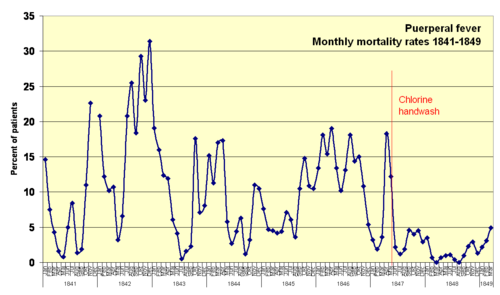
He had the answer. He had the data to prove it. He had the chart above to show anyone willing to look.
The Response
The medical establishment rejected him. His colleagues found his findings offensive — the implication that doctors themselves were causing patient deaths was too uncomfortable to accept. He was not diplomatic about it, which did not help. But the deeper problem was not his manner. It was the politics. He was challenging a consensus held by people with far more institutional power than he had, and they were not interested in being proved wrong.
He was eventually dismissed. His mental health deteriorated. He died in an asylum in 1865 at the age of 47, having never seen his ideas accepted in his lifetime. Within years of his death, Pasteur and Lister would confirm germ theory and vindicate everything he had been saying. By then it was far too late.
What This Has to Do With Software
I think about Semmelweis often when I see good ideas get buried inside organizations. Not because the stakes are the same — they rarely are — but because the mechanism is identical. Someone identifies a real problem, applies real thinking to it, and produces real evidence that something needs to change. And instead of engaging with the idea, the organization manages the person. Moves them sideways. Reduces their influence. Waits for them to stop pushing.
It happens with Agile adoption. It happens with technical debt conversations. It happens any time someone with data and common sense challenges a process that powerful people are invested in protecting.
The lesson I take from Semmelweis is not about martyrdom. It is about what organizations lose when they let politics override evidence. Semmelweis was not a perfect messenger. But the message was right, and the cost of ignoring it was measured in lives.
The next time someone brings you a differing opinion — especially one backed by data — try putting the knives away and actually listening. That idea might be the paradigm shift you have been waiting for. It might even be the one that saves the patient.